Cardiac Ablation
Treatment Duration
2 – 4 Hours
Recovery Time
3 – 6 Weeks
Treatment Cost
$3,000 – $7,000
Hospital Stay
3–10 Days
Treatment Type
Cardiac Ablation
Specialist
Electrophysiologist
Cardiac Ablation
Heart disease is one of the leading causes of health complications worldwide and can affect people of different ages. Conditions involving the heart and blood vessels may require medication, lifestyle management, minimally invasive procedures, or specialized cardiac surgery depending on the patient’s diagnosis and severity. Medivoyage Global helps patients access experienced cardiologists, cardiac surgeons, advanced hospitals, modern diagnostic facilities, and specialized treatment options for a wide range of cardiovascular conditions.
Cardiac treatment is highly individualized. The recommended treatment depends on the patient’s symptoms, medical history, heart function, blood vessel condition, diagnostic reports, age, and overall health. Tests such as ECG, echocardiography, stress testing, cardiac CT, MRI, coronary angiography, and other investigations may be used to understand the condition and determine the most appropriate treatment approach.
Medivoyage Global assists patients in coordinating consultations and treatment with qualified cardiologists, interventional cardiologists, cardiac surgeons, electrophysiologists, and other cardiac-care specialists.
Comprehensive Cardiac Care
The cardiovascular system includes the heart and a network of blood vessels responsible for circulating blood throughout the body. Problems affecting the heart or blood vessels can lead to symptoms such as chest discomfort, shortness of breath, fatigue, irregular heartbeat, dizziness, swelling, or reduced exercise tolerance.
Depending on the condition, treatment may involve medicines, lifestyle changes, catheter-based procedures, minimally invasive interventions, or open-heart surgery. Early diagnosis and appropriate treatment planning are important for managing cardiovascular conditions and reducing the risk of serious complications.
At Medivoyage Global, we help patients coordinate their medical journey by assisting with specialist consultations, hospital selection, appointment scheduling, medical documentation, treatment planning support, travel arrangements, accommodation, and follow-up coordination.
Heart Bypass Surgery (CABG)
Coronary Artery Bypass Grafting (CABG), commonly known as heart bypass surgery, is a major cardiac procedure used to improve blood flow to the heart muscle when coronary arteries have become significantly narrowed or blocked.
During CABG, the surgeon uses a healthy blood vessel taken from another part of the patient’s body to create a new pathway around the blocked or narrowed coronary artery. This allows blood to reach the heart muscle through the bypassed section.
CABG may be recommended for patients with significant coronary artery disease, particularly when multiple coronary arteries are affected or when other treatment approaches may not provide an appropriate solution.
Before surgery, patients undergo detailed cardiac evaluation. After the procedure, hospital monitoring and cardiac rehabilitation may be required. Recovery varies according to the patient’s overall health and the complexity of the surgery.
Congestive Heart Failure (CHF) Treatment
Congestive Heart Failure (CHF) is a condition in which the heart cannot pump blood as effectively as the body requires. It can result from various underlying cardiovascular problems, including coronary artery disease, high blood pressure, heart valve disease, or damage to the heart muscle.
Heart failure treatment focuses on managing symptoms, improving heart function where possible, reducing the risk of hospitalization, and improving quality of life.
Treatment may include prescribed medications, dietary and lifestyle modifications, management of underlying conditions, device-based therapies, and in advanced cases, specialized surgical or advanced heart-failure treatments.
Because heart failure can vary significantly from one patient to another, treatment must be carefully planned and monitored by a qualified cardiology team.
Coronary Angioplasty
Coronary angioplasty, also known as percutaneous coronary intervention (PCI), is a minimally invasive procedure used to restore blood flow through a narrowed or blocked coronary artery.
During angioplasty, a thin catheter is guided through a blood vessel to the affected coronary artery. A small balloon may be inflated at the narrowed area to improve blood flow. In many cases, a stent is placed to help keep the artery open.
Coronary angioplasty may be performed in patients with significant coronary artery narrowing and may also be used in certain emergency situations involving an acute blockage.
Compared with open-heart surgery, angioplasty generally involves smaller access sites and a shorter hospital stay for appropriately selected patients. The treating interventional cardiologist determines whether angioplasty is suitable based on the patient’s symptoms, angiography results, and overall cardiovascular condition.
Cardiac Ablation
Cardiac ablation is a specialized procedure used to treat certain abnormal heart rhythms, also known as arrhythmias. These conditions occur when abnormal electrical signals cause the heart to beat too quickly, too slowly, or irregularly.
During catheter-based cardiac ablation, specialized catheters are introduced through a blood vessel and guided toward the heart. The specialist identifies the area responsible for the abnormal electrical signals and uses energy to create controlled areas of tissue modification that interrupt the abnormal electrical pathway.
Cardiac ablation may be considered for selected patients with conditions such as certain forms of tachycardia, atrial flutter, and other rhythm disorders.
The procedure is generally performed by an electrophysiologist, a cardiologist who specializes in the electrical system of the heart. Patients require monitoring following the procedure, and follow-up care is planned according to the specific rhythm disorder and treatment response.
Aortic Valve Replacement (AVR)
Aortic Valve Replacement (AVR) is a procedure used to replace a damaged or diseased aortic valve. The aortic valve controls blood flow from the heart’s left ventricle into the aorta. When the valve becomes severely narrowed or does not close properly, the heart may have to work harder to pump blood throughout the body.
Aortic valve disease can include conditions such as aortic stenosis and aortic regurgitation. When the condition becomes severe and symptoms or other clinical findings indicate the need for intervention, valve replacement may be considered.
Valve replacement can be performed using different approaches depending on the patient’s age, health, anatomy, valve condition, and surgical risk. In appropriate patients, traditional surgical valve replacement may be recommended, while selected patients may be candidates for minimally invasive or catheter-based procedures such as Transcatheter Aortic Valve Replacement (TAVR).
A multidisciplinary heart team evaluates the patient and determines the most appropriate treatment approach.
Advanced Cardiac Diagnosis and Treatment
Accurate diagnosis plays an important role in successful cardiac treatment. Depending on the patient’s symptoms and suspected condition, specialists may recommend ECG, echocardiography, coronary angiography, cardiac CT, cardiac MRI, Holter monitoring, stress testing, or other investigations.
Modern cardiology has also advanced considerably, with minimally invasive catheter-based procedures, advanced imaging, modern cardiac surgery techniques, specialized implants, and electrophysiology procedures providing additional treatment options for appropriately selected patients.
The choice of treatment should always be based on a comprehensive evaluation rather than a single test or symptom.
Cardiac Rehabilitation and Recovery
Recovery is an important part of cardiac care. Depending on the treatment, patients may require a structured rehabilitation program after procedures such as CABG or other major cardiac interventions.
Cardiac rehabilitation can include supervised physical activity, nutritional guidance, lifestyle recommendations, education, and monitoring. The objective is to help patients gradually return to appropriate daily activities while supporting long-term cardiovascular health.
Patients should follow their cardiologist’s or cardiac surgeon’s instructions regarding medication, physical activity, diet, follow-up appointments, and other aspects of recovery.
Why Choose Medivoyage Global for Cardiac Treatment?
Choosing an appropriate hospital and experienced cardiac specialist is an important decision, especially for patients traveling for medical treatment. Medivoyage Global helps simplify the medical travel process by coordinating access to suitable hospitals and qualified cardiac specialists.
Our services may include:
- Cardiologist and cardiac surgeon consultation coordination
- Hospital and treatment-center selection
- Medical report and diagnostic document coordination
- Treatment planning assistance
- Appointment scheduling
- Travel and accommodation coordination
- Local assistance during treatment
- Post-treatment follow-up coordination
Our goal is to provide patients and their families with organized medical travel support while helping them connect with appropriate healthcare professionals.
Your Cardiac Treatment Journey
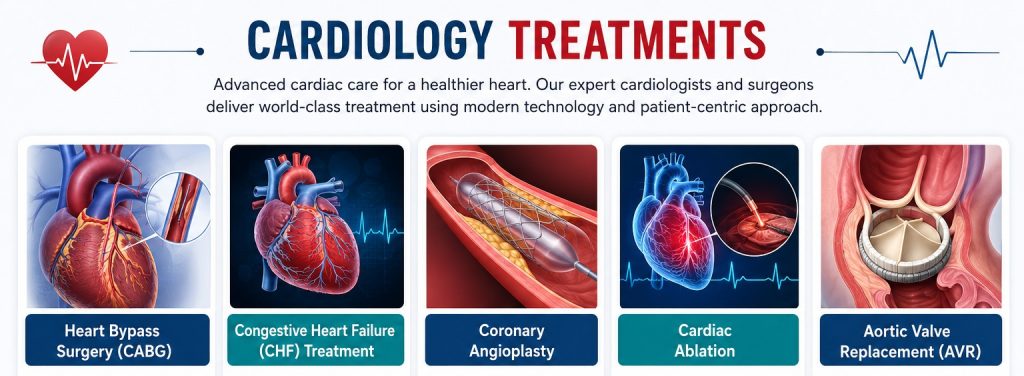
Whether you require Heart Bypass Surgery (CABG), Congestive Heart Failure Treatment, Coronary Angioplasty, Cardiac Ablation, or Aortic Valve Replacement, the appropriate treatment depends on your individual diagnosis, medical history, test results, and overall health.
At Medivoyage Global, we help coordinate your journey from initial specialist consultation through treatment and follow-up care. Our team can assist with connecting you to appropriate cardiac specialists and healthcare facilities based on your medical requirements.
If you are considering cardiac treatment, you can share your medical reports, previous treatment details, diagnostic images, and current prescriptions with Medivoyage Global. Our team can coordinate your case with the appropriate specialists for further evaluation and treatment planning.
Important: Treatment options, cost, hospital stay, and recovery time vary from patient to patient. The final treatment plan should always be determined by a qualified cardiologist or cardiac surgeon after a complete medical evaluation.
Related Treatment
- Heart Bypass Surgery (CABG)
- Congestive Heart Failure (CHF) Treatment
- Coronary Angioplasty
- Cardiac Ablation
- Aortic Valve Replacement (AVR)
- Spinal Fusion
- Minimally Invasive Spine Surgery (MISS)
- Cervical Artificial Disc Replacement
- Laminectomy
- Lung Cancer Treatment
- Breast Cancer Treatment
- Liver Cancer Treatment
- Thyroid Cancer Treatment